Related PostWhy Hire a Developer When AI Can Code? Here’s the Real Answer
In an era of ubiquitous AI tools, content creation has become easier and faster than ever before. Whether it's a company's social media posts, blog articles, or even advertising copy, AI can generate complete content in seconds, simply by providing a few keywords and requirements. But is AI truly replacing creativity? Is AI truly omnipotent? While AI can make work more efficient, it's still a machine tool, lacking the human touch and storytelling power of human beings.
Humans are emotional creatures, and content that resonates deeply with audiences often has a "warmth" quality. This article will explore the balance between AI content generation and human creativity, examining how companies can leverage AI tools to save time while maintaining a unique brand voice and emotional connection.
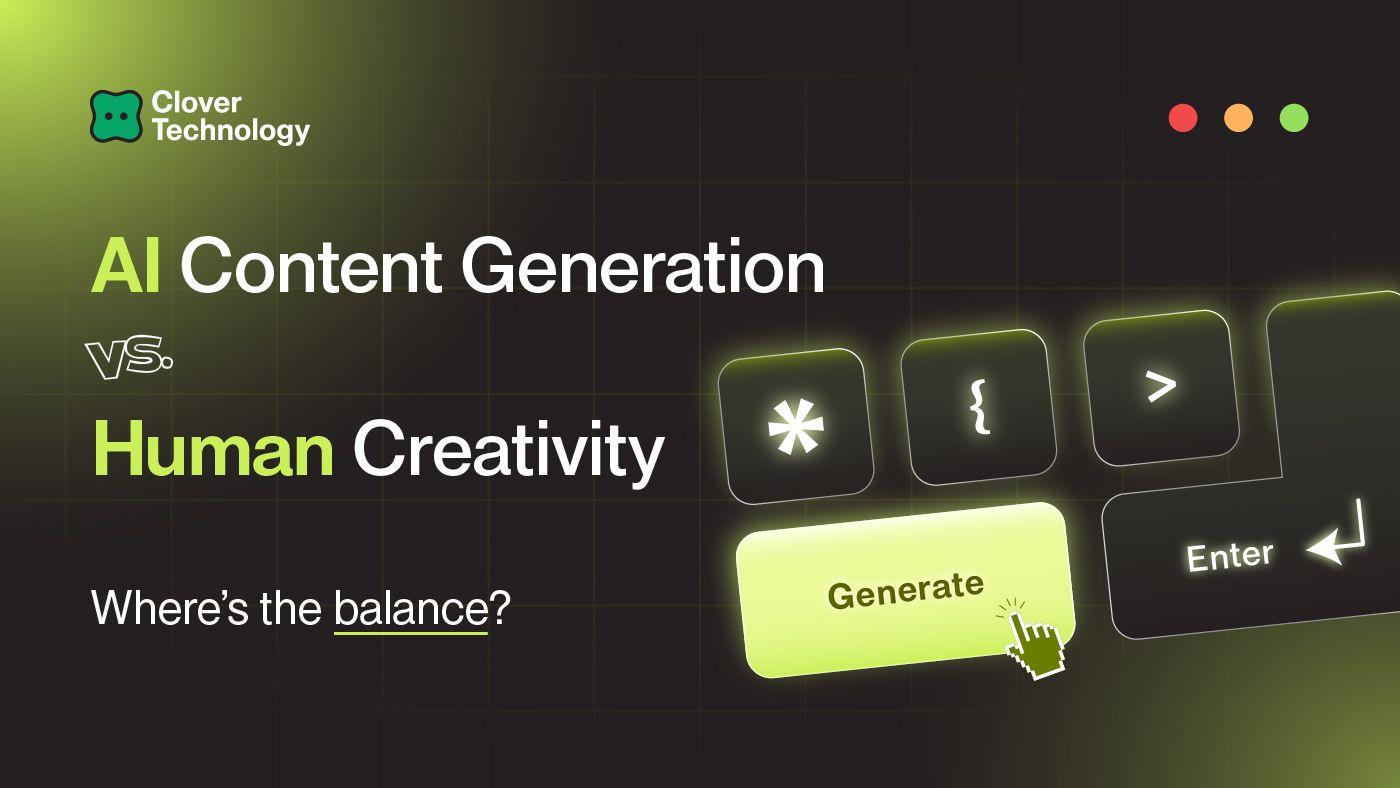
AI content generation is reshaping the way we create, blending speed and automation with the need for human creativity and emotional resonance. It sets the stage by highlighting both the power of AI and the importance of balance with human input.
When AI first began to develop, AI content creation exploded in popularity due to its astonishing speed. Companies leveraged AI tools like ChatGPT, Jasper, and DeepSeek to successfully transform nearly the entire marketing and writing landscape. The clearer the keywords and requirements, the higher quality of the resulting articles, advertising slogans, and even film scripts.
However, as more and more companies adopted AI tools, a major problem emerged: the resulting content became increasingly similar or repetitive. This led to plagiarism and creative theft.
The content created by AI tools often felt too rigid in tone, sentence structure, and expression. It was too perfect, yet lacked the unique "personality" that characterizes humans. Overly mechanical content often struggles to attract attention, stand out in the market, and resonate with readers.
So, how can we strike a balance between speed and originality? How can we effectively integrate them?
Can AI tools be a "booster" for creativity, rather than a "substitute" for it?
As we all know, the defining characteristic of AI tools is their efficiency.
From collecting information, organizing key points, and composing a draft to completing a piece of content, it takes a considerable amount of time and effort. However, AI makes this a breeze. It can create a first draft in seconds and even provide easy-to-understand information for reference.
Key AI functions:
These are the most basic and primary functions of AI, but AI is much more than that.
AI tools can also generate images and videos. While the process can be challenging, patiently providing the AI tool with the desired image and video features and descriptions can successfully generate perfect content.
If a company needs to publish 10 pieces of content or product introductions per week, manual effort would be a challenge, especially when inspiration is lacking. However, AI tools can now effectively provide inspiration and help generate image or video ideas.
Effective use of AI can reduce costs by 50% and enable faster response to market trends. AI can also analyze:
By adjusting based on this data, businesses can quickly achieve targeted marketing.
So why are AI tools so effective?
The core principles behind them are natural language processing (NLP) and machine learning (ML), which:
For example, if a user enters “write an article about AI marketing,” the AI will automatically search and understand what “AI marketing” is, analyzing its concepts and trends. It will then create sentences based on the tone and wording you specify, and then incorporate the provided keywords into the article.
While AI is highly efficient, it's still a machine without emotions.
It can generate sentences, articles, images, videos, and more, but it lacks true understanding of empathy. Humans' greatest value lies in imbuing these creative works with emotion and warmth. Through storytelling, tone, and cultural expression, they imbue text with a human touch.
For example, when a company creates an "About Us" page, AI only generates information about the company's founding date and services. But there's more to the company than just that: it likely includes the employees' work ethic, the office atmosphere, and interactions with customers. These are things AI cannot understand.
Is AI truly emotionless?
It can mimic emotions, but it can't truly understand them.
Although AI tools are created by humans, they draw their insights from algorithms and data, not from personal experience. AI tools are simply fed with data, so even if the tone of the content they create resembles human emotions, it still remains cold and impersonal.
It understands sadness and joy, but it lacks empathy.
AI can write, "The feeling after a breakup is like swallowing a stone in my chest, unable to speak or breathe." But it can't understand why it feels this way. It was just a piece of data it had pieced together from millions of poems.
Humans often add more stories, why they break up, why they feel this way.
Human writing is so moving because it's imbued with emotional memories, cultural background, and subjective experience. When writing, humans infuse genuine empathy, empathizing with feelings of desolation, hope, and courage.
Even if AI can create content in a fraction of the time, it's still humans who truly resonate and shape the essence of a brand.
AI cannot replace humans, but it can be their best assistant. As the name suggests, it can quickly and efficiently collect information and data, write the first draft, and polish the language, achieving more efficient and rapid content creation.
AI's strengths lie in speed and scale.
It can quickly create a wide range of headlines, analyze trending topics, and even provide the most effective data for human reference. It can also help with grammar and suggest SEO keywords.
Because it is an emotionless tool, it cannot determine how to effectively reach the target audience, nor can it understand the unique voice and cultural background of a brand or company.
This is where the value of humans lies.
Humans are creative, emotional, storytelling, and value-driven creatures. Combining the strengths of AI with those of humans can create even more exceptional content. This is called "human-machine collaboration."
How does this work? It's simple, leverage the strengths of AI tools:
If a small or medium-sized enterprise needs to write a "company story" online, AI tools can effectively create a smooth introduction based on the input information. However, only humans can incorporate the founder's experience, the team's emotions, and the brand's philosophy. This creates a highly effective piece of writing while also adding emotion to the text.
Still unsure how to combine these elements? Clover Technology's IT consulting services can help businesses integrate these capabilities. We help clients select the right AI tools, establish an efficient content creation process, and enable teams to benefit from the speed and efficiency of AI while retaining the creativity and storytelling of humans.
Can't businesses do it themselves? Of course, there are some shortcomings, and businesses lack expertise in this area, making it difficult to perfectly integrate AI and human content.
Why is it so difficult for businesses to perfectly integrate AI and human content? Isn't this a simple task? Many people are undoubtedly skeptical. If so, read on.
While many businesses understand that combining AI and human content is the ideal model, achieving a balance is difficult.
The main reasons are:
This is how AI can maximize its efficiency, rather than undermining human creativity.
For example, a local coffee brand began using AI tools to create daily posts and advertising copy to attract more customers. Initially, they saved a lot of time and gained a significant following on social media. However, over time, followers began to notice that their posts were stilted and lacked emotional engagement.
Later, with guidance from IT consulting services, the brand team transitioned to an "AI-generated, human-polished" approach: AI created the first draft, while humans refined the tone, storytelling, and emotion. The result was a 45% increase in follower engagement, and a more approachable and natural brand image.
With another example, a retail company used AI tools to generate advertising copy for a promotion. The AI quickly generated dozens of variations, but each one had a consistent tone and lacked creativity.
However, under Clover's guidance, they redesigned the process, with AI handling the draft and humans incorporating brand expectations, emotions, and cultural elements into the copy.
A retail company used AI tools to generate advertising copy for a promotion. The AI quickly generated dozens of variations, but each had a consistent tone and lacked creativity. After the new copy was launched, the conversion rate increased by nearly 50% compared to the previous AI automatic copy.
AI tools are certainly useful, but the most important thing is how to balance AI's efficiency with human creativity. Here are five key points:
By completing these steps, you can achieve the high efficiency of AI while retaining human emotion and creativity.
AI tools are humans' best friends, making content creation faster and more convenient. However, it's human creativity that truly resonates. AI brings speed, humans bring souls. The best content isn't created by AI or humans alone, but a combination of both.
If companies want to stay ahead in the content competition, they must learn to use AI wisely, not rely solely on it. Clover Technology can help companies find this balance, ensuring your Oh i Steak continues to stand out in the AI era.
Curious about how to stand out using AI? We'd love to help.
Contact us now, and we'll be right there in a split second.